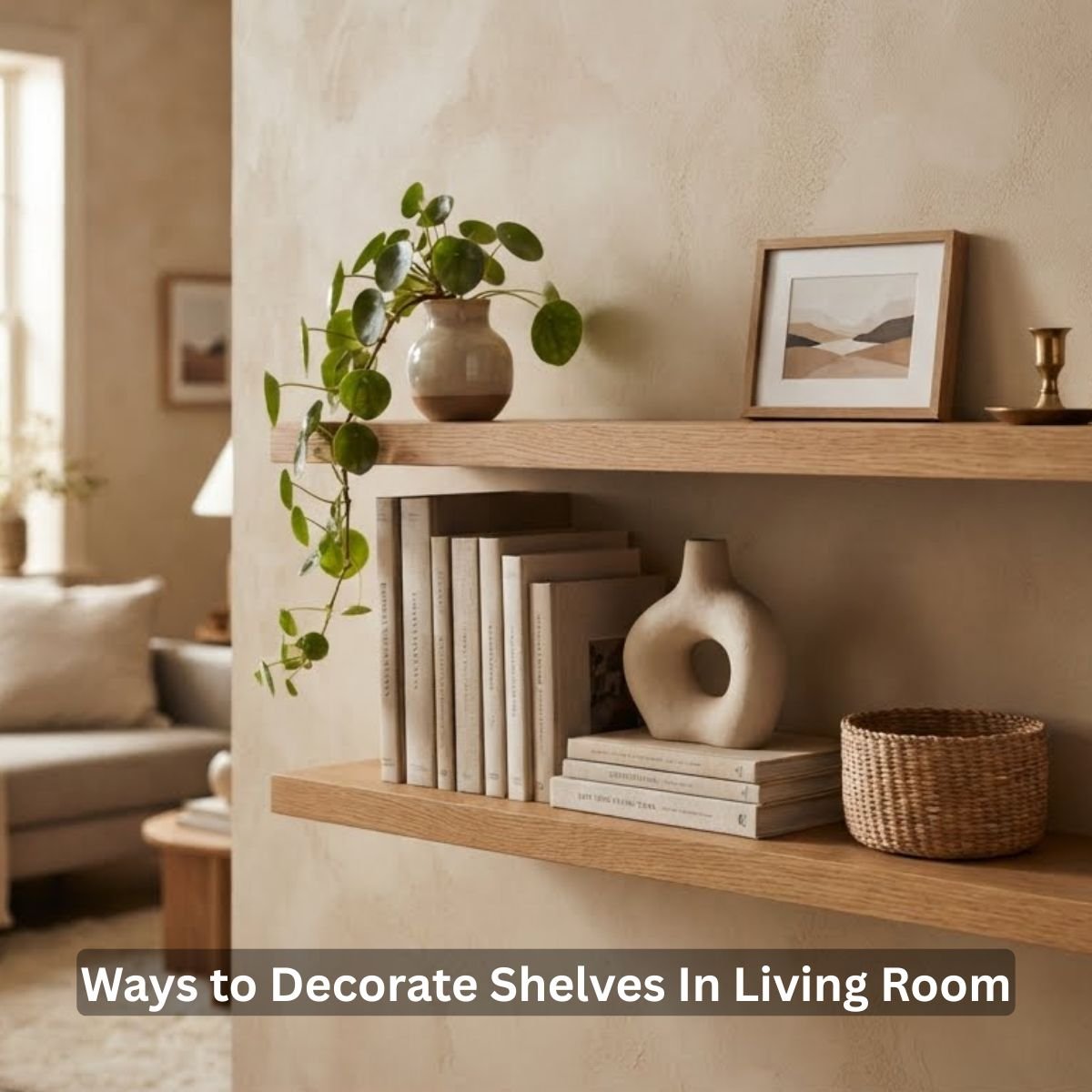
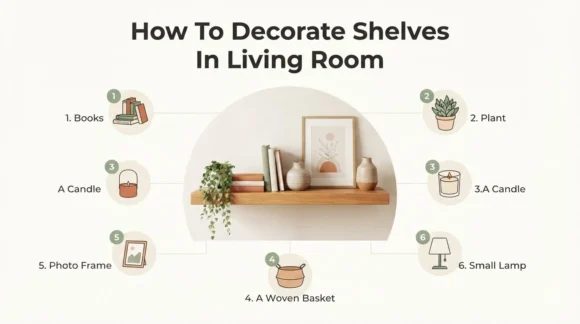
How To Decorate Shelves In Living Room: 15 Stunning Styling Secrets Every Home Needs

In my years of experience helping homeowners fall back in love with their living rooms, I have noticed that shelves are almost always the most neglected part of the space.
People spend weeks picking the perfect sofa or the ideal rug, and then they shove a few random items on their shelves as an afterthought. But here is the truth: well-styled shelves can become the true focal point of your living room.
They tell your story, show off your personality, and pull the entire room together. If you have been staring at your empty or cluttered shelving unit wondering where to even begin, you are in the right place.
Below, I am sharing my favorite tried-and-tested ways to decorate shelves in your living room so they look curated, cozy, and completely magazine-worthy.
Layer Books Both Vertically And Horizontally
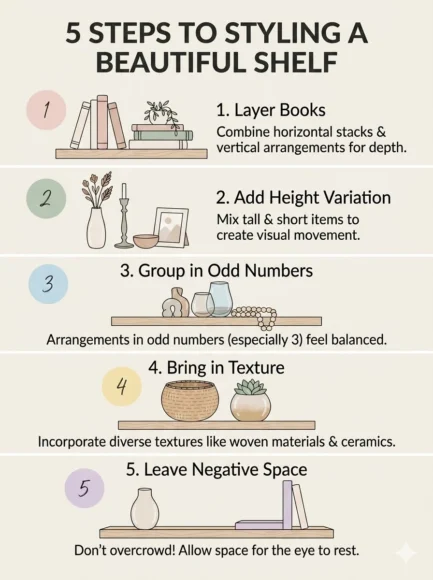
One of the simplest ways to add instant depth to your shelves is by mixing how your books sit. Stack a few books flat in a low pile and let others stand upright beside them. This creates a natural, lived-in rhythm instead of a stiff, uniform line.
For an image reference, picture a warm wooden shelf with a stack of five hardcover books lying flat, topped with a small ceramic vase, next to a row of eight upright books leaning slightly to one side, soft natural window light falling across the spines.
Add A Statement Piece Of Art
A small framed painting or print leaning against the back of your shelf instantly adds a gallery-like feel. Choose one piece that has a color echoing something else in your room, like a throw pillow or curtain.
Visually, imagine a narrow floating shelf with a small framed abstract painting in muted terracotta tones propped against a soft cream wall, angled slightly forward, with a single trailing plant beside it.
Use Varying Heights With Bookends
Uneven heights create visual interest, but you still need structure so it does not look messy. Decorative bookends in brass, marble, or wood can hold a small book collection upright while adding their own sculptural charm.
Picture a pair of polished brass geometric bookends shaped like triangles, holding six colorful book spines between them, placed on a walnut wood shelf with soft afternoon lighting.
Introduce Texture With Woven Baskets
Not every shelf needs to be filled with hard, glossy objects. A small woven basket adds warmth and softness, and it is also useful for hiding remote controls or coasters.
Envision a compact rattan basket with a rounded shape sitting on the left side of a white floating shelf, paired with a stack of linen-bound books and a small brass candle holder nearby.
Group Items In Odd Numbers
This is a classic designer trick that never fails. Grouping decor in threes or fives feels more natural to the eye than pairs. Try a candle, a small plant, and a framed photo together on one shelf.
Picture a styled vignette with a slim white taper candle in a ceramic holder, a small potted succulent, and a mini framed black-and-white photograph, all clustered together on a light oak shelf.
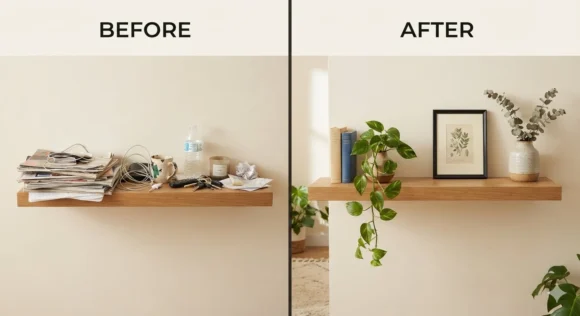
Bring In Greenery For A Fresh Look
Plants instantly make any shelf feel alive. Trailing plants like pothos or ivy look stunning cascading over the edge of a shelf, while small potted succulents work well on tighter spaces.
Imagine a trailing green pothos plant in a round white ceramic pot placed at the edge of a dark wood shelf, its vines gently spilling downward against a neutral wall.
Play With A Cohesive Color Palette
Random colors scattered across a shelf can feel chaotic. Instead, choose two or three colors that repeat throughout your styling, like sage green, cream, and warm brass. This creates a sense of calm and intention.
Picture a shelf styled entirely in soft sage green pottery, cream-colored books, and small brass accents, all coordinated against a warm white wall.
Mix Old And New Pieces Together
Vintage finds add character that brand-new decor simply cannot replicate. A thrifted ceramic vase or an antique wooden box mixed with your modern decor adds instant charm and depth.
Visualize a weathered vintage ceramic vase with a crackled glaze finish sitting beside a sleek, modern minimalist clock, both placed on a light wood floating shelf.
Create Negative Space On Purpose
Believe it or not, empty space is just as important as filled space. Leaving some breathing room between objects allows each piece to stand out and prevents the shelf from feeling overcrowded.
Picture a clean, minimal shelf with just three carefully placed objects, a tall vase, a small stack of books, and a single candle, with generous open space between each item.
Use Trays To Organize Small Items
Tiny trinkets and small collectibles can look cluttered if scattered loosely. Placing them on a small decorative tray instantly makes them feel curated and intentional.
Imagine a round brass tray holding three small ceramic trinket dishes and a mini glass perfume bottle, placed neatly on the corner of a white floating shelf.
Incorporate Personal Photographs Thoughtfully
Family photos add warmth, but too many can feel cluttered. Choose one or two framed photographs with matching frame finishes and place them among your other decor rather than lining them all in a row.
Picture a single slim black metal photo frame with a candid family photograph, leaning against the back of a wooden shelf beside a small potted plant and a stack of neutral-toned books.
Add Lighting For A Cozy Evening Glow
A small battery-operated LED strip or a tiny lamp tucked onto a shelf can completely transform the mood of your living room at night. Soft, warm lighting makes your styled shelf glow like a true design feature.
Envision a warm golden LED light strip tucked along the underside of a floating shelf, casting a soft glow over a curated arrangement of books, a small plant, and a ceramic sculpture below.
Style Shelves Around Your TV As A Design Feature
If your shelving flanks a television, do not treat it as an afterthought. Balance each side with similar heights and weights so neither shelf overpowers the screen. This turns an ordinary media wall into an intentional, gallery-style feature.
Picture two matching floating shelves on either side of a mounted television, each holding a small stack of books, a single plant, and one framed print, mirrored in a balanced, symmetrical arrangement.
Rotate Decor With The Seasons
A shelf does not need to look the same all year. Swapping in seasonal touches, like a small pumpkin in autumn or a bud vase with fresh tulips in spring, keeps your living room feeling current without a full redesign.
Imagine a light wood shelf styled with a small ceramic pumpkin, a stack of amber-toned books, and a woven basket, evoking a warm autumn color palette against a soft cream wall.
Use Shelves To Zone An Open Floor Plan
In open-concept living rooms, a tall shelving unit can double as a soft divider between the living and dining areas without closing off the space. Style the side facing each room differently so both areas feel finished. Picture a tall open-back wooden shelving unit positioned between a living area and a dining area, styled with books and ceramics on one side and a small plant grouping on the other, light passing through the open shelf gaps.
Common Mistakes To Avoid When Styling Shelves
Even with the best ideas in mind, a few small missteps can throw off the entire look of your shelves. One common mistake is pushing every item flush against the back wall, which flattens the display and removes any sense of depth.
Instead, pull a few pieces slightly forward so the arrangement feels layered when viewed from across the room.
Another frequent issue is matching everything too closely. When every object is the same material, color, or shape, the shelf can start to look like a store display rather than a lived-in home.
Mixing textures like wood, ceramic, glass, and woven fiber keeps things feeling collected over time rather than bought all at once.
Overcrowding is also a big one. It is tempting to display every collectible or photo frame you own, but a shelf packed edge to edge quickly reads as cluttered rather than curated. If you find yourself running out of room, rotate pieces in and out seasonally instead of trying to fit everything at once.
Finally, many people forget to consider sightlines. Stand at the entrance of your living room and check how the shelf looks from that angle, not just from directly in front of it.
A shelf that looks great up close but disappears or looks unbalanced from the doorway is not doing its job as a design feature.
Choosing The Right Shelf Style For Your Space
Before you even begin styling, it helps to think about the type of shelving that best suits your living room. Floating shelves work beautifully in modern or minimalist spaces since they create a clean, airy look without visible brackets. A traditional bookcase, on the other hand, offers more storage and works well in classic or transitional interiors where a grounded, furniture-like piece feels appropriate.
Open shelving units, especially ladder-style or etagere designs, are ideal for smaller living rooms because they add storage and display space without visually blocking the room.
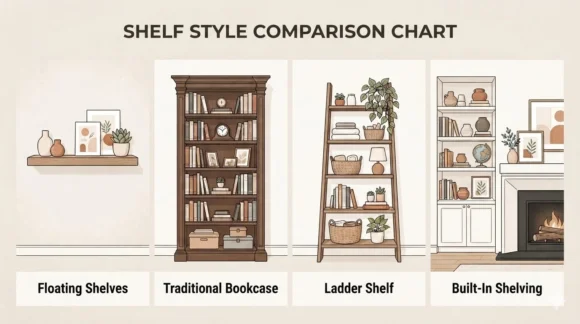
Built-in shelving, while a bigger investment, offers the most polished and permanent solution, particularly around a fireplace or in an alcove where custom-fit shelves make the whole wall feel intentional.
Whichever style you choose, the styling principles above will still apply, so pick the shelf that fits your room first, then style it with confidence.
Final Thoughts
Decorating your living room shelves does not require a big budget or a professional designer. What it really takes is a little patience, an eye for balance, and a willingness to experiment until it feels right.
Start with just one or two of these ideas, step back, and see how the space feels. Over time, your shelves will become one of the most personal and beautiful parts of your living room, a place that truly reflects who you are and how you love to live.
Frequently Asked Questions
What should I put on empty living room shelves?
Start with a mix of books, one plant, and a single decorative object like a vase or small sculpture. Group items in odd numbers and vary the heights so the shelf feels balanced rather than empty or overstuffed.
How do I decorate shelves on a budget?
Use what you already own before buying anything new. Thrifted vases, books you already have, and a single inexpensive plant can go a long way. Rearranging existing decor in fresh groupings often makes the biggest visual difference for the least cost.
How much should I put on a shelf so it does not look cluttered?
A good rule is to fill about seventy percent of the shelf and leave the rest as open space. This breathing room lets each item stand out instead of competing for attention.
Should every shelf in the living room match?
Not exactly. Aim for a consistent color palette and style across all your shelves, but let each one have its own small variation so the room feels curated rather than mass-produced.